This free Korean spice tolerance test tells you how much Korean heat you can actually handle — before you land in Korea and find out the hard way. Everyone asks the same question before a Korea trip: “Will the food be too spicy for me?” The honest answer — it depends on which table you sit at. Korean food runs from gentle, savory soups your grandmother would approve of, all the way to fire noodles that come with their own warning videos on YouTube.
So instead of guessing, find out. Seven quick questions, and you’ll get your Korean Spice Survival Level — plus real dishes from our restaurant reviews in Daegu and Daejeon that match your level. Every dish on this site is something we actually ate and paid for.
🌶️ Interactive Test
Can You Handle Korean Spice?
7 quick questions. Get your Korean Spice Survival Level — and real dishes from our restaurant reviews that match it. No signup, no nonsense.
Your Korean Spice Survival Level
🍽️ Dishes from our reviews at your level
Levels are based on typical spice in each dish as we experienced it. Everyone’s tongue is different — that’s the fun part.
How spicy is Korean food, really?
Here’s the thing most first-time visitors get wrong: Korean heat is not the same as Mexican or Thai heat. Korean spice comes mostly from gochugaru (red chili flakes) and gochujang (fermented chili paste). It builds slowly, carries a sweet-savory depth, and doesn’t usually attack your tongue on the first bite — it ambushes you around bite five.
For calibration: a jalapeño sits around 2,500–8,000 on the Scoville scale. Shin Ramyun, the famous red instant noodle, is roughly 2,700. The original Buldak fire noodles are about 4,400 — and the 2x version roughly doubles that. So if you can eat jalapeños comfortably, most everyday Korean food is well within your range.
And plenty of beloved Korean dishes have zero burn: kalguksu (handmade noodle soup), baeksuk (herbal chicken or duck soup), bossam (boiled pork wraps), gukbap, and most jjigae can be enjoyed by anyone. Spice is a choice in Korea, not a requirement.
The spice ladder we use in our reviews
- Level 1 (Mild) — no meaningful heat: kalguksu, duck baeksuk, doenjang-jjigae home-style meals
- Level 2 (Easy) — gentle warmth: bossam with spicy kimchi, seasoned fried chicken, market snacks
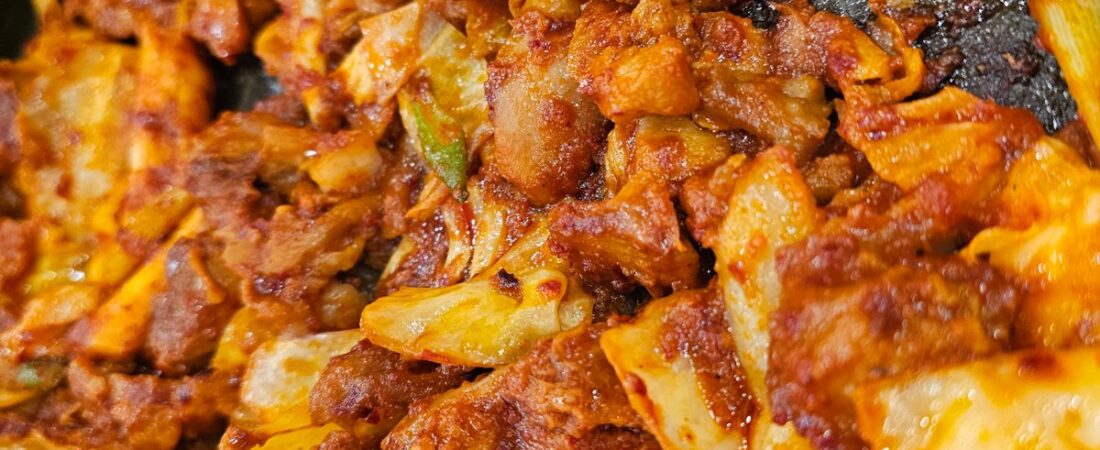
- Level 3 (Medium) — a proper local table: dakgalbi, tteokbokki, most “spicy” menu items at their default setting
- Level 4 (Hot) — locals call this spicy: Daegu-style spicy galbi-jjim, aggressive jjamppong
- Level 5 (Fire) — challenge territory: buldak 2x and anything a Korean friend dares you to try
Every restaurant review on this site now carries one of these spice tags, so the test above always shows you our latest matching reviews — it updates itself as we eat our way through Korea.
Korean phrases that save your tongue
- 안 맵게 해주세요 (an maepge haejuseyo) — “Not spicy, please”
- 덜 맵게 해주세요 (deol maepge haejuseyo) — “Less spicy, please”
- 물 좀 주세요 (mul jom juseyo) — “Water, please” (you’ll need this one)
- 우유 있어요? (uyu isseoyo?) — “Do you have milk?” (the real emergency exit)
Quick questions travelers ask
Is Korean food spicier than Thai or Mexican food?
On average, no. Thai bird’s eye chilies and Mexican habaneros score far higher on the Scoville scale than Korean gochugaru. What makes Korean heat feel intense is volume and persistence — spicy broths and sauces coat everything on the table, so the burn builds through the whole meal instead of hitting in a single bite.
What is the spiciest Korean food?
In everyday restaurants, Daegu-style spicy galbi-jjim and aggressive jjamppong sit near the top. In convenience stores, Buldak 2x fire noodles are the famous ceiling — most Koreans treat them as a dare, not dinner. If your Korean spice tolerance test result came out at Level 4 or 5, that’s your hunting ground.
Can I ask for less spicy food in Korea?
Yes, almost everywhere. Most kitchens will happily tone a dish down if you ask when ordering — use the phrases below and you’ll be fine. Tourist-friendly areas often have picture menus with little chili icons marking the heat, too.
Got your level? Share it with the friend who claims they can “handle anything” — and if you’re heading to Daegu or Daejeon, our Food Journey reviews will show you exactly where to put that tolerance to work.
Still not sure which dish to start with? Let fate decide — spin the Korean Food Roulette and get a dish from our reviews matched to a single click.
Feeling lucky beyond the dinner table? Draw your Korean Lotto 6/45 numbers too — spice tolerance and lottery luck are both best tested before Saturday.